


01
Hydrogen storefronts
Shopify’s React framework with Server Components and edge-first rendering, deployed to Oxygen with no hosting contract to manage.
Headless Commerce · Hydrogen & Oxygen
Hydrogen and Oxygen, or Next.js on infrastructure you own, both running on Shopify’s Storefront API. Built by Shopify Partner engineers who will tell you when a theme is still the right answer.
48 hours turnaround
Send your store URL and we reply with a recorded walkthrough: five prioritised fixes, ranked by revenue impact. No pitch, no obligation.
Your details stay with us. We never share or sell them.
01 / CAPABILITIES
Hydrogen on Oxygen, or Next.js on your own infrastructure. Both sit on Shopify’s Storefront API, and both are a trade rather than an upgrade.
01
Shopify’s React framework with Server Components and edge-first rendering, deployed to Oxygen with no hosting contract to manage.
02
The same rendering model on infrastructure you own: App Router, Server Components, ISR and on-demand revalidation.
03
Shopify’s global edge runtime for Hydrogen, with a preview deployment per branch so review happens on real URLs.
04
Catalogue, cart, customer accounts and checkout handoff modelled once, then shared across every front end you run.
05
Sanity, Contentful or Payload for editorial content, with preview so your team sees a page in context before it is live.
06
Shopify-hosted checkout, Shop Pay and the wallets kept intact. Headless changes the storefront, not the payment flow.
07
Template-by-template migration behind a redirect map, so the organic surface you spent years paying for survives the move.
08
Two systems means two release cycles. Dependency, runtime and performance work continue as part of the engagement.
02 / PROCESS
Headless is a trade, not an upgrade. The first stage exists to make sure you are making that trade knowingly.
Stage 1
We audit what Liquid is actually costing you. About half the brands who ask for headless leave with a plan to fix the theme instead.
Stage 2
Front end, CMS, hosting and the Storefront API surface get decided and written down before the first component is built.
Stage 3
Templates ported behind a redirect map, on staging running a real copy of your catalogue rather than sample products.
Stage 4
Launch against a written rollback plan, then the release, dependency and performance cadence a headless stack needs to stay healthy.
03 / OUR WORK
Live stores, apps and platforms we have built and run. Case studies open on this site; other projects open the live build in a new tab.
2×
Conversion uplift
typical after a CRO-led rebuild
60%
Faster load times
median improvement at launch
40%
Lower cost
against an in-house team of the same size
99.9%
Uptime
on Shopify infrastructure

Case study · Shopify Plus · Health
Prescription-aware checkout, doctor-consultation flow and a 10K+ SKU catalog tuned for sub-2s mobile loads.

Shopify app · Shopify Plus · CRO
A public Shopify app that adds modular blocks to the Plus checkout — AI product recommendations, checkout upsells, custom fields...
App Store listing: Checkout Bricks: Checkout Extensibility App for Shopify Plus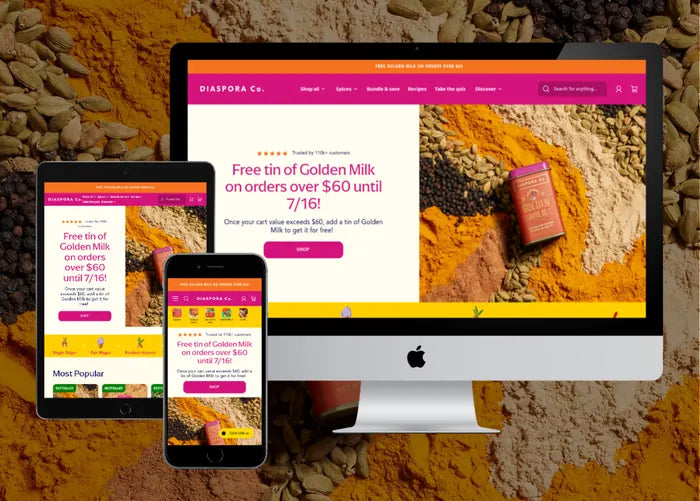
Shopify Plus · Food & beverage · Shopify
A Shopify storefront for a single-origin spice brand sourcing from 150+ family farms across India and Sri Lanka. Roughly 40...
Live site: Diaspora Co.: Single-Origin Spice DTC Storefront on Shopify
Case study · Shopify Plus · F&B
Perishable shipping rules, gift-tuned checkout and drop-day traffic spikes handled without a wobble.
04 / PRICING
Fixed-scope projects, ongoing retainers, or full-time dedicated teams. Whatever the engagement, you'll see the price before you sign: no hourly creep, no surprise change orders.
Project
$5K – $250K
Fixed timeline · Milestone-billed
Best for: Store launches, redesigns, migrations, mobile apps, MVPs
Retainer
$1.2K – $12K / mo
15–150 hrs/month · Month-to-month
Best for: Established stores running CRO, A/B tests, & ongoing improvements
Dedicated team
$8K – $40K / mo
1–8 engineers · Embedded in your roadmap
Best for: In-house augmentation, Shopify Plus brands, multi-region scaling
05 / WHY BRANDS STAY
Most of our Shopify work is repeat business or referral. These are the reasons clients give when we ask why.
Certified, with direct partner support channels when a build needs them.
Seven years of Shopify-specific pattern recognition, not general web work.
One accountable owner, weekly written updates, no account-manager telephone game.
Design decisions are argued from revenue impact, and measured after launch.
Written scope and a fixed number before work starts. No surprise line items.
Clean handover, documented, on your repos. Leaving is never held over you.
06 / TECH STACK
Shopify’s own headless stack where it fits, and a framework you host yourself when the build genuinely needs one.
07 / FAQ
Honest answers, including the ones most agencies dodge.
Usually not yet. Headless solves rendering and composition problems, not app bloat or an unoptimised theme. We audit what Liquid is actually costing you first, and about half the brands who ask leave with a plan to fix the theme.
Hydrogen is Shopify’s React framework, deployed to Oxygen with the hosting included. Next.js is the same rendering model on infrastructure you own and pay for. The choice is mostly about who runs the operations.
No, and you should not want to. Checkout stays Shopify-hosted with Shop Pay and the wallets intact. Headless changes the storefront in front of checkout, not the payment flow behind it.
Every template is migrated behind a redirect map covering your existing organic surface, and structured data is rebuilt per template. Nothing goes live until URL parity has been checked.
Not in the theme editor, and that is the real cost of headless. Editorial content moves to a headless CMS with preview, and merchandising controls have to be designed and built rather than inherited.
It depends on template count, CMS scope and whether you host it yourself. We scope it in writing with a fixed number before work starts — the engagement models above show the shapes we work in.